

Argentina
A country with so much potential that should be rich....
It's a big country and I only saw part of the highlight reel...
The Good: It's cheaper than Uruguay, Buenos Aires is a cool big city, La Plata is a truly beautiful and well designed city (one of my favorites), the Iguazu Waterfalls are simply amazing, the Jesuit mission ruins are intriguing, people are lively/friendly, customs is a breeze, great bbq.
The Interesting: Fun fact, I never saw a coin in Argentina, only paper money, but prices still have cents, so they just round up or down when you pay. Also, you will see random street art saying the Falkland Islands (UK) are part of Argentina.
The Negative: I went to a dozen ATMs in Buenos Aires, and they all wanted to charge a $10 - 16 fee for any transaction, but I could still not withdraw money. First time I ever had to western union myself money to get cash on a trip. Next, a dog sleeping on the street in San Ignacio tried to bite my leg as I was walking 1 block away from the bus stop to leave town.
Quick facts: Source: CIA World Factbook
Area: 4 times the size of Alaska
Population: 47 million
Ethnic groups: European and Mestizo (mixed European and Indigenous) 97.2%, Indigenous 2.4%, African descent 0.4%
Language: Spanish (official), also some European and Indigenous languages
Religion: Catholic 62.9%, Evangelical 15.3%, other 2.6%, none 18.9%
Capital: Buenos Aires
GDP Per Capita: $21,500
Currency: Peso ($1 = 1,424 Pesos)
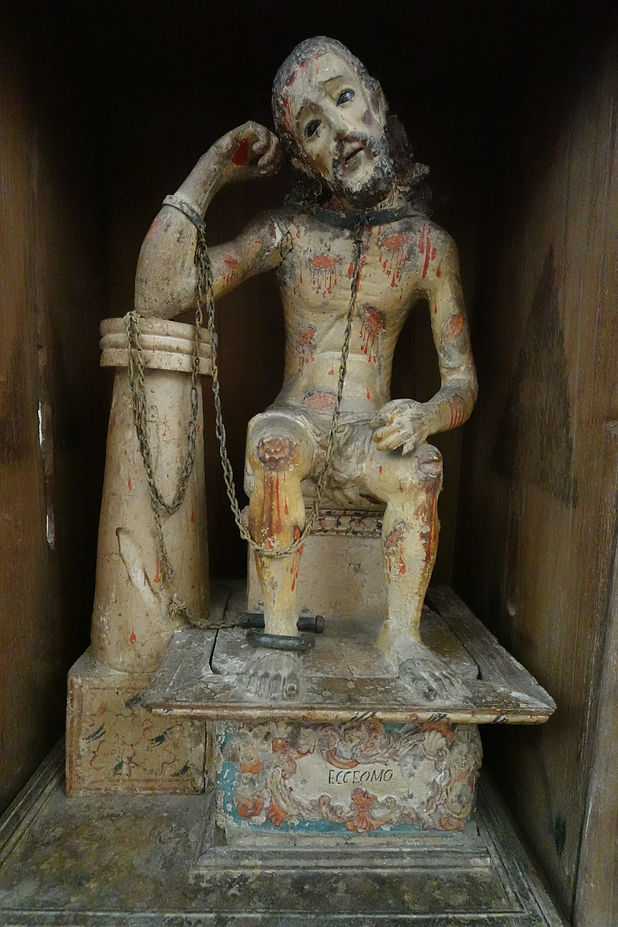
San Fransisco Basilica Museum, Buenos Aires
Argentina
A country with so much potential that should be rich....

Trip Summary
Date: September 25 - October 3, 2025 (Oct 5th in Posadas, Argentina because Paraguay didn't stamp my passport and I forgot to check...)
Map Source: Google Maps
Route: Buenos Aires > La Plata > Puerto Iguazu (South America's largest waterfalls) > San Ignacio (Ruins from 1700s Jesuit Mission) > Posadas > Encarnacion (Paraguay) > Posadas
Hit a snag: Paraguay didn't stamp my passport. According to Google, travelers might have to pay a fine leaving Paraguay if their passport isn't stamped....so I went back to Argentina and still could not get a stamp from customs when reentering Paraguay. A smiling official explained that they no longer stamp passports in Encarnacion because the system went online/digital now. I hope she is right...I saved my train ticket crossing the border just in case it's a problem later when leaving the country.

Buenos Aires
Walking the few blocks from the ferry dock to my hostel, I immediately felt the sheer size of the city. The main roads were wide, the buildings were tall, the roads between blocks were one way streets with bollards to separate road/pedestrian traffic, and there were bars, restaurants, etc. on the ground floor of every building. The next day, I went to the main square and confirmed Buenos Aires is a huge (3.1 million in the urban area), beautiful city (it even has a subway). Monuments, tall buildings in different architectural styles, grand old churches, and museums...it has all the essential parts of a great city. Although, I did notice quite a few homeless people.


La Plata
Even though Buenos Aires is beautiful and lively, I'm not a big city guy, so I headed to the nearest smaller city: La Plata. This is possibly one of the best designed cities ever. It's a square city with diagonal roads running through it like an X, and a ring round around the outside. Beyond that, it's big enough to have everything, but not so big to be smothering. Even more, the plazas/squares were lovely green spaces filled in the evening with locals drinking mate (tea like drink). The city has many of these green spaces (parks, plazas, squares) evenly spaced about every 5 blocks. Finally, there were some incredible buildings downtown, including the Cathedral de La Plata. It's a 20th century church with a museum in the ground floor explaining how it was built (some of the pictures reminded me of the guys working on the Empire State Building). Opened in 1932, 1 year after the Empire State Building, this neogothic masterpiece is in the top 100 tallest churches in the world. La Plata really is a great town and my favorite "city" of the trip so far.


Iguazu Waterfalls
The weather/lighting wasn't ideal, but at least it didn't rain. The waterfalls were impressive, and there are 2 different walking paths (lower to see the falls and upper to be on the river before it goes over the cliffs). But, after a short narrow gauge train ride to about a half mile walkway across the river, nothing prepares you for the sheer roar of water as it crashes down over "The Devil's Throat." Unfortunately, it was very busy there, shoulder to shoulder, and for about $35 dollars for a foreigner's ticker (only $11 for Argentina residents), they really could have made the viewing platform larger. Regardless, it's one of the best parks I've ever been to, and the walking paths were almost empty. My favorite part was seeing all the birds gliding in and out of the mist all around The Devil's Throat, which you can see in the video clips below (#3,4).


San Ignacio
Small town, big history. Simply, Spain/Portugal came to Latin America with guns, germs, and missionaries. The continent wasn't empty, and different Indigenous peoples inhabited Indoamerica. This area (mainly Paraguay, northeast Argentina, and southwest Brazil) was home to the Gaurani people (they were also the ones to cultivate the yerba mate plant used to make the popular mate drink). The Spanish encouraged spreading Catholicism through their new colonies, and one group to begin organizing Gaurani into settlements were the Jesuits (AKA the Society of Jesus). San Ignacio was home to one of these Jesuit missions, which were called "reductions" in Spanish. Basically, a "reduction" was an collection of Indigenous people organized in one area in order to convert them to Catholicism and adapt to European culture. The Jesuits were active in Latin America from the 1500s until they were expelled by the Spanish/Portuguese Crown in 1767-1768. However, other religious institutions/orders took over where the Jesuits left off in these areas. From my reading of the history books, these missions were controversial then and now. The positive: the Jesuits protected the Guarani in these reductions by keeping them from being used as forced labor/serfs by the Spanish colonizers. The negative: their ultimate goal was to convert them to Catholicism, have them live/work in these reductions, and I would imagine they would like them to become culturally European too...
The mission at San Ignacio specifically was founded in 1610 but didn't settle into this location until 1696. Later, it was destroyed by Brazilian forces in 1817, and it became a UNESCO World Heritage Site in 1984. These are considered the best preserved Jesuit mission ruins in Argentina.


