

Serbia
Where national identity, religion, and history are deeply connected.
Serbia might appear small on a map, but Belgrade feels like a big European city. It has all requirements: a fort in the old town, a tram system, pedestrian streets for eating and shopping, a vibrant nightlife, museums, traffic, beautiful cathedrals, and it sits on the banks of a river.
Post trip thoughts: Serbia was more developed than I expected. Almost everyone spoke some English and people were friendly. The dominant flavor in traditional foods was "salty," but the pizza shops were excellent, and the coffee was good. Renting a car was easy, but gas is very expensive. There are toll roads, and the normal roads are smooth but winding and often extremely narrow in the villages, which means you can't drive very fast.
Quick facts: Source: CIA World Factbook
Area: About the size of South Carolina
Population: 6.5 million
Ethnic groups: Serbian 83.3%, Hungarian 3.4%, Bosnian 1.9%, Romani 1.4%
Language: Serbian: Official (Slavic language family using both Cyrillic and Latin Alphabets)
Religion: Orthodox 84.6%, Catholic 5%, Muslim 3.1%, Protestant 1%
Capital: Belgrade (Beograd)
GDP Per Capita: $24,500
Currency: Dinar ($1 = 108 Dinar)

Entrance to Potpece Cave
Serbia
Where national identity, religion, and history are deeply connected.

Trip Summary
Date: 20-30 September 2024
Route: 5 days in Serbia; 5 days in Bosnia and Herzegovina
Map Source: Google Maps
21-22 = Belgrade: Old Town Fort, Military Museum, Tower
23 = Stupovi Monastery, Novi Pazar
24 = St Peter and Paul Church, Sopocani Monastery, Studenica Monastery, Open Air Museum Old Village in Sirogojia, Zlatibor
25 = Potpece Cave, back to Belgrade, bus to Visegrad (Bosnia and Herzegovina)

Belgrade
Belgrade Fortress, Military Museum, Nebojsa Tower, and Millennium Tower
Belgrade Fortress (including Kalemegdan Park) rests on a hill where the Danube and Sava Rivers meet. Inside the fortress walls you will find a lookout tower, churches, a zoo, a gallery, and the Military Museum (One of the nicest national history museums I've ever visited). Also included in the area are a Roman well, Nebojsa Tower, gunpowder warehouse, Sahat Tower, and other exhibitions. On Sunday morning, there were few visitors. I was the only guest inside the museum, and the staff was very friendly and outgoing.

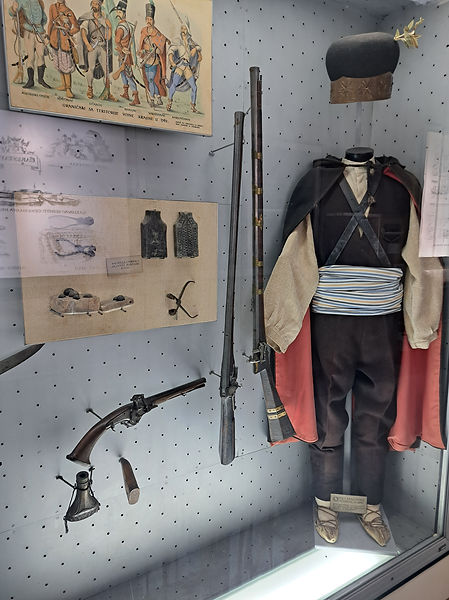
Military Museum: Overall, the exhibits and displays are well built, aesthetically pleasing, and educational. If you are a gun and sword enthusiast, this museum doesn't disappoint. For a small price, about $3, you can travel through time from the ancient to the modern history of the Balkans. As you can see in the summary below, the past here has been a constant struggle between external powers for domination and the Serbians' struggle for national sovereignty.
Brief 2,000 Year History: What began as a Roman military camp, was transformed from a small fortified Byzantine town to the Slavic city called Beli Grad (White City), which became Belgrade.From the 9th century on, the city was dominated by the Bulgarians, Byzantines, Hungarians, Serbians, Hungarians again, Serbians once more in 1404, Hungarians after Serbian King's death, Ottoman Turks took the city in 1521, Austrians in 1688, Ottoman Turks again in 1690, Austria again 1717, Ottomans in 1739, Austria in 1789 but left after signing a treaty. A Serbian uprising in 1804 fizzled by 1813, and the fortress diminished in importance after it was handed over to Serbians in 1867. The area then became used mainly as a park with improvements in paths and landscaping. Many of the interior buildings were destroyed in WW1. For more detailed information about the Belgrade Fortress today and its history checkout their website: https://www.beogradskatvrdjava.co.rs/?lang=en
Nebojsa Tower sits guard on the Danube River. Built around 1460 as a defensive structure for the lower town's port, this is the best preserved Belgrade Fortress tower. Housing cannons, it was instrumental in the fortress defenses during the Ottoman siege in 1521 (after it fell, the city followed). Later, in the late 18th and early 19th century under Ottoman rule, it functioned as a dungeon for several important political prisoners. After some renovations, it now stands as a permanent exhibition honoring the Greek revolutionary Rigas Feraios (imprisoned here in 1798). He was killed along with his accomplices while being transported from the Nebojsa tower to Istanbul to be sentenced by the Sultan Selim III. Rigas was a Greek revolutionary, political theorist, and writer.

Millennium Tower (sometimes called Gardos Tower) is perched on a hill on the west side of the Sava River, opposite side of the Belgrade Fortress. The tower sits on the remains of the Zemun Fortress. The original citadel walls date back to the 14-15th century. The actual tower was built in 1896 to mark 1,000 years of the Hungarians in Pannonia (a province of the Roman Empire including parts of modern Austria, Hungary, Slovenia, Croatia, Serbia, and Bosnia and Herzegovina). Today, it's an excellent place to get an amazing view of the Danube River and Belgrade below. The church steeples rising above the burnt orange clay tile roofs highlights the historical European feel of the city.


Novi Pazar
Stupovi Monastery, St Peter and Paul Church, Sopocani Monastery, Studenica Monastery
Novi Pazar (meaning New Bazaar) is an anomaly in modern Serbia. A majority of the city's population is Muslim while over 90% of the country's population identifies as Christian. Historically, the city was rebuilt after the Ottomans conquered the area in the 15th century. According to Britannica, Novi Pazar was "burned three times by the Serbs in the 19th century." Today it's a nice little town and jumping off point to see some of the most important sites for Serbian Orthodoxy and Serbian national history. The old capital of Serbia in the 12th century, Stari Ras, was positioned roughly 5 miles west of Novi Pazar. In the surrounding area are 4 of the oldest Orthodox churches/monasteries in Serbia. Although not far away on a map, getting to these places in a rental car did take longer than expected. They are found in the hills, sometimes surrounded by forests, only reachable by winding narrow roads, and away from any urban or town centers. Hopefully this remoteness provided some security to the monks residing there over the centuries.

Mosque directly across the street from my hotel.

Stupovi Monastery was built in the late 12th century on a hill above Novi Pazar and is among Serbia's oldest monasteries. 2 royal patrons of the monastery were Stefan Nemanja (the founder of the Serbian dynasty which lasted from 1166-1371) and King Dragutin, who finished the construction and was buried here. Sadly, Stupovi was abandoned in 1689 during the Austrian-Turkish War. It was burned several times and sat in ruins for the last 3 centuries. Thankfully, it has been restored based on photos taken between the World Wars. Despite its previous destruction, some remnants of older frescoes still remain inside. Part of these frescoes were moved to the National Museum in Belgrade. In 2002, a living area was built, and after centuries of abandonment, the monks returned.
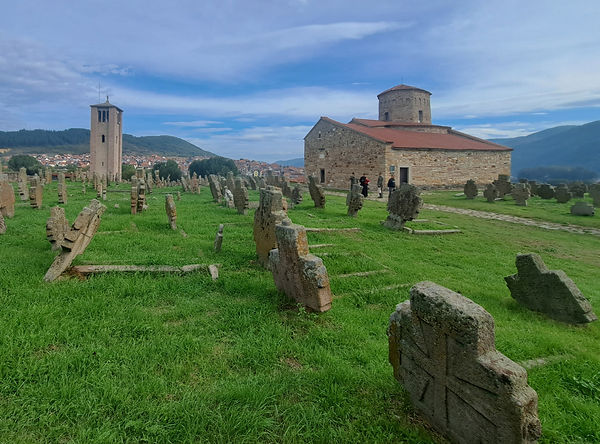
St Peter and Paul Church is possibly the oldest Serbian church still in use, and it's surrounded by an Orthodox cemetery. The original church was built in the 9-10th century, and the frescoes inside date back to the 10th, 12th, and 13th centuries. Most of the remaining frescoes are from renovations during the reign of Stefan Nemanja (lived 1113-1200). Unfortunately, this church was destroyed in the 17th century. The graves include tombstones from the 12th, 13th, 16th, and 19th centuries. Visitors can climb up to the second story, walk along the dome's perimeter, and view the church floor from above. While I was there, the priests were outside conversing with 2 uniformed soldiers and nurses (a military base is nearby).

Sopocani Monastery was constructed in the mid-13th century as a donation from Serbian King Stefan Oros I. Like others, this monastery was caught in the Austrian-Turkish crossfire and destroyed in the 17th century. Rebuilding began in the 20th century. The interior includes frescoes dating back to the 1270s which are considered to be the most impressive displays of medieval Byzantine and Serbian art. It's hard to overstate how impressive it was to see almost the entire inside of the church, wall to wall, floor to ceiling, covered in frescoes of varying completeness. While visiting, there were two people inside, possibly artists, working quietly on scaffolding below the dome area of the church. Outside the old monastery walls, there's a new residence for the monks.
Studenica Monastery was different than the others I visited in the area in 2 noticeable ways. First, there were 4 churches inside the walled area (only 3 stand today, but the foundation of the 4th is still present). Second, the monks' quarters and other buildings exist inside the walled area, not outside. Even the bell tower and perimeter wall are more complete here than at the others. This monastery was also established by Stefan Nemanja in the 12th century. Also, Stefan and his wife Anastasia were laid to rest here. According to UNESCO, "it's the largest and richest of Serbia's Orthodox Monasteries...enshrines priceless collections of 13th and 14th century Byzantine painting." Studenica Monastery was, and remains, the most important Orthodox monastery in Serbia.

Of these 4 historic religious places, the first I visited (Stupovi Monastery) had a sole priest inside reciting liturgy, the second (St Peter and Paul Church) had one gentleman inside who went outside after selling me an entrance ticket, the third (Sopocani Monastery) was unoccupied spare two artists working on scaffolding, and only the fourth (Studenica Monastery) had more than two people inside. It was a gloomy, rainy day, so maybe I was just lucky to have these places almost all to myself. It was a privilege to walk, gaze, reflect, and ponder the centuries that past since these magnificent structures were built, the frescoes were painted, the royals and pilgrims alike who stepped here before me, and all the generations of people who lived through these places laying in ruin and never having the chance to see them rebuilt. Maybe the cool rain made it all feel even more authentic since you can imagine over all those centuries of a war, struggle for national sovereignty, and subjugation, there must have been many gloomy days.
Medieval Serbian Monasteries: First, these monasteries and churches were usually placed on hilly, rural areas. Next, they were walled in structures with living quarters inside and a tall bell tower. In Sopocani Monastery, the bell tower was connected to an actual church, but it was a separate structure in the others. To an outsider, these institutions resemble a round fortification: up on hill, the high stone walls, the gated entrances, the tall towers, the living quarters inside. Possibly it was designed this way for safety, exclusivity, tradition, etc.
Orthodox Churches Today: Like Muslim mosques, there's a dress code for men and women. No shorts, sleeveless shirts, or other revealing clothing, and women should cover their hair. Also, I noticed the popularity of wax candles being used inside the church and placed outside in special areas. Possibly every singe Orthodox church I entered had a candle lit inside, outside or both. Another interesting observation is that the area in the very back of the church, behind the dome, was walled off with saloon type doors the length of a wall. Growing up Roman Catholic, these are just a few surface level differences.


Sirogojia
Open Air Museum Old Village
This unique outdoor history museum is a bit off the beaten path, at least the way Google Maps guided me there, and about 15 miles east of the better know and quickly growing ski town Zlatibor. It was a lovely drive there passing through rolling green farmland with grazing livestock, clear fields, and at times very, very narrow roads. Each roughly century old structure in the village was moved here from the surrounding area. The entrance to each building includes a snip about the family who formerly occupied them, bringing visitors closer to the former owners. Inside, each place is filled with authentic folk items giving visitors a sense of what daily life and living conditions were actually like for the ancestors of the Zlatibor region.


St Peter and Paul Church is an original building in the museum. Inside, on both sides of the entrance are memorials listing the people from this area/perish who were killed from 1912-1918. There were 3 separate conflicts during this long 7 years for the country: the First Balkan War 1912-1913, the Second Balkan War 1913, and WW1 1914-1918 (Austria-Hungary declared war on Serbia July 28, 1914 after the assassination of Archduke Franz Ferdinand a month earlier in Sarajevo by a Serb nationalist Gavrilo Princip). Roughly 25-30% of the Kingdom of Serbia's population would perish during the First World War.

Brandy Distillery: From two-part chalet houses, to a pigsty, a stable, a cask workshop, a pottery workshop, a dairy, barns, etc, this open air museum displayed a myriad of traditional occupations and workshops necessary for the village to function. However, my favorite traditional building and profession was the structure covering "the cask with cauldron for making brandy." Different cultures have different beverage preferences and wine is to Italy as brandy is to Serbia (the national specialty is plum brandy and another kind called rakija, which is produced/consumed all through the Balkans).

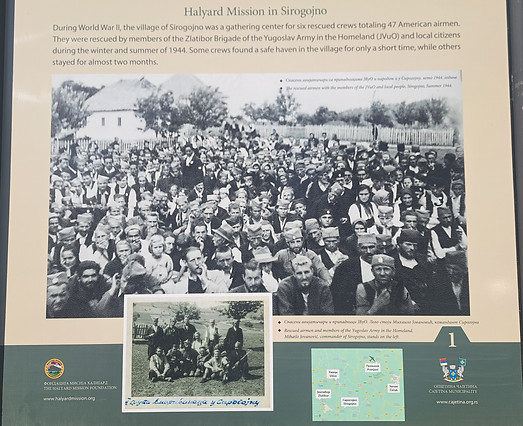
Halyard Mission in Sirogojno: Some stayed here for up to 2 months. A plan was made to rescue them using an improvised airfield in Pranjani. The airmen's liberation would come on December 27, 1944 when they, along with 417 people of various nationalities were airlifted out. To learn more, visit the Halyard Mission Foundation Website.
Halyard Mission in Sirogojno: I stepped out of the rental car at the museum entrance, and my first sight was this sign. US Bombers began attacking the Nazis in Southern Europe in late 1943, and many planes didn't make it back. They crash landed or bailed out over this area. During the winter of 1944, 47 US Airmen were were rescued by locals and partisan forces fighting the Nazi occupation.


Zlatibor
Amusement Park, Shopping Area, Gondola, and Villas for Rent
In the off season, when there's no snow, this burgeoning ski-town has a new downtown area with an amusement park, a giant pool with fountains and a nightly light show, and cozy pedestrian areas with shops and eateries. Also, there's construction in all directions. Like Novi Pazar, this area is also a jumping off point for other nearby destinations. About 25 miles from Zlatibor is Potpece Cave (one of the largest cavern opening in the Balkans according to the tour guide).

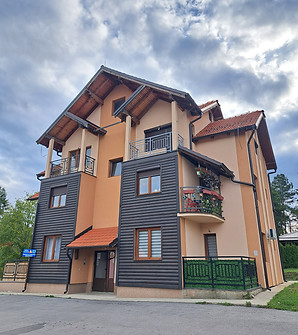

Being September, it was easy to find a cheap villa for the night, about $30. I arrived about dusk, which was perfect timing to catch the Ferris wheel all lit up. Just down the street from the amusement park was an incredibly large man-made pool with fountains, jets every several yards lining the perimeter and spraying water towards the center, and a lights and music show playing. It gives the visitors and locals something fun and lively to see at night. Like most tourist towns in the off season, only shops on the main drag were open, and establishments closed fairly early. Before heading out in the morning, I walked away from the city center and examined the outskirts of town. Every other building seemed to be either brand new or under construction. Currently, this area is really booming.


Potpece Cave
2 Level Cave Entrance
For 4 Euros, you get a guided tour in English. It's filled with lots of geological information, historical tidbits, and different nick names for natural features inside the cave (most of which I cannot remember). What I do remember though is that: I was the only visitor, a walkway at ground level lead into the lower section of the cave, a staircase on the left side lead up to the top level of the cave, and the cave entrance was massive!

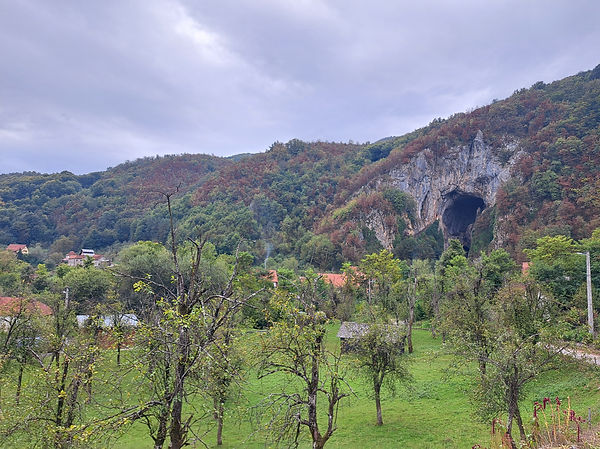
Potpece Cave takes the name of the little village nearby. From the upper entrance of the cave, you get a nice picturesque view of the whole area. The cave penetrates deep into the northern edge of the Dreznicka Gradina Mountain. Inside, there are replicas of all the different kinds of ancient artifacts previously found inside the cave: pottery, bee keeping jugs, animal remains, burial sites, etc. Overall, stalactites (grow down from the ceiling) out number stalagmites (growing up from the floor). A spring that becomes a river and runs underneath forms the cave. A little before the entrance, there's even a fish farm pond built into the center of the small fast flowing river and a restaurant close by. Unfortunately, the tour only covered a small section of the entire cave complex on the upper level.


