

Tajikistan
Tagline about country
Tajikistan is a small landlocked, mountainous country bordering China and Afghanistan. Sadly, it went through a civil war following the breakup of the Soviet Union that ended in 1997. Currently, it's a peaceful place with a growing economy and a safe destination for tourists. Northern cities like Panjakent and Khujand will satisfy the history lovers while the Pamir Mountains are an outdoorsman's delight. Additionally, Tajikistan's national dish, plov (osh), is both delicious and aesthetically pleasing in its presentation.
Post trip thoughts: Tajikistan was more traditionally Muslim than I expected, and almost every woman was wearing some form of a hijab. Dushanbe has the feeling of a growing city with a small population with its massive parks and new apartment buildings. Most surprising were all the new Chinese EV taxis roaming the city. But, huge pictures of the longtime President Emomali Rahmon on every government building gave me North Korea vibes...Overall, people were friendly, and I had a few nice conversations. It's definitely a place worth visiting again.
Quick facts: Source: CIA World Factbook
Area: About the size of Iowa
Population: 10.3 million
Ethnic groups: Tajik 84.3%, Uzbek 13.8%, Other 2%
Language: Tajik (Official) is a variant of Persian using the Cyrillic alphabet
Religion: Muslim 98% (Sunni 95%, Shia 3%), Other 2%
Capital: Dushanbe
GDP Per Capita: $4,500
Currency: Somoni ($1 = 10.34 Somoni)

Central Asia
A graveyard of empires.

Trip Summary
Date: March 28 - April 12, 2025
Map Source: Google Maps
29-31 = Dushanbe, Tajikistan
1-3 = Termez, Uzbekistan
3-5 = Bukhara, Uzbekistan
5-7 = Samarkand, Uzbekistan
7-8 = Tashkent, Uzbekistan
9 = Turkistan, Kazakhstan
10 = Taraz, Kazakhstan
10-11 = Talas, Kyrgyzstan
11-12 = Bishkek, Kyrgyzstan

Tajikistan
Tagline about country

Trip Summary
Date: March 28 - April 1, 2025
Route: Dushanbe to Termez, Uzbekistan
Map Source: Google Maps
29 = Land in Dushanbe - See Downtown
30 = Hissar Fortress (Hisor)
31 = Victory Park (WW2 Memorial)
1 = Taxi to border - Shared taxi to Termez

Dushanbe
Istiklol Monument, Victory Park, and the National Museum of Tajikistan
Dushanbe: First impressions of downtown are:
-
Lots of parks, squares, and public spaces.
-
New governments buildings, gates, and monuments everywhere.
-
The President's huge photo can been seen on the front of many government buildings.
-
Traffic is surprisingly good on the main roads.
-
Taxis are Chinese EVs, and they use an app on their phone as a meter.
-
People were friendly, sometimes curious, and I did get a free taxi ride once.
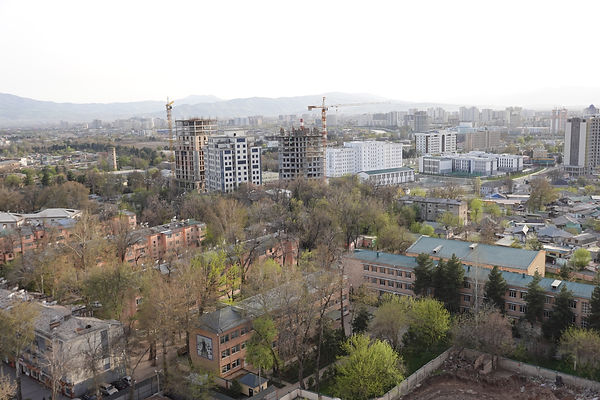

Monument Istiklol: Also know as the Independence and Freedom Monument, it's at the center of a massive square with 3 different entrance gates down wide pedestrian boulevards to the north, south, and east. During the day, and later at night, it was surprising how few people were actually in this park (it's not called a park, but it's basically a giant park). The peacefulness of these types of areas gave Dushanbe a sense of being a sparsely populated capital city. Unfortunately, the observation deck was not open when I was there. According to a Xinhua article, this structure was built as a gift from the Chinese leader Xi Jinpingto the people of Tajikistan.
Victory Park: Built to commemorate the end of WW2 and the Soviet victory over the Germans, this park has a simple but powerful monument to remember the largest war in human history. Symbolically, a T34 tank sits front and center of the monument. Notice the tank is marked 201...currently there are still Russian soldiers stationed in Tajikistan at the Russian 201st Military Base in Dushanbe. I guess it serves as a vivid reminder to local park visitors that Tajikistan was once part of the Soviet Union, and they are still inside the Russian sphere of influence.


The National Museum of Tajikistan: With displays and exhibits on 3 levels, there is a lot to see and learn about this region's history. Some information in English is available, and almost every item on display has a description in 3 languages: Tajik, Russian, and English. For me, the best part of the museum was the photos of important historical sites and the section detailing the pre-Islamic history of the region. For centuries, Central Asia was dominated by Zoroastrianism, Buddhism, and lesser known religions like Nestorian Christians and Manicheans. The museum was empty except for a few staff members and some children playing around.
Plov (Osh): This beautiful, delicious, and filling dish is the national food of Tajikistan (although similar dishes are eaten all over the region). Simply, it's a rice, vegetable, and meat dish made in a huge pot, kettle, drum type of container with a lot of oil, seasonings, etc. It's mixed with shovel sized spatulas, topped with sliced meat, and served with pickled vegetables, yogurt, salsa, broth, and bread. They all tasted great, but this one was my favorite in Tajikistan because of the little quail eggs (I'm guessing) and the small sarma. I ate everything but the thin green pepper!


Hisor
Hissar Fortress
Fort: The guidebook gave a conflicting description of this place. It's technically historical, but little of the original structure remains. It's been rebuilt but labeled more of an event center, place to have your picture taken, or a tourist trap, and less of a destination for history buffs. However, it's about 1 hour on a bus/taxi to get here from Dushanbe, and there are some old madrasas in front of it to see as well. For me, it was definitely worth the trip.

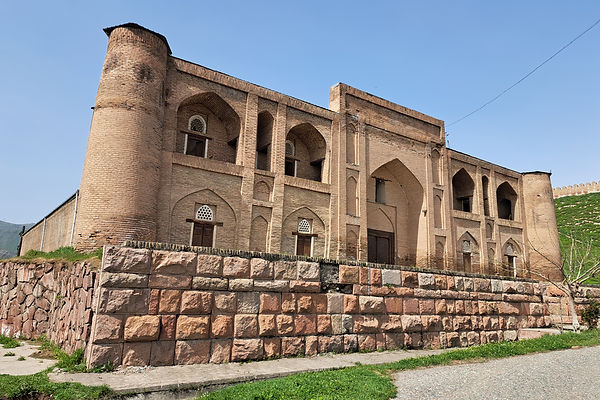
New Madrassa (Muslim religious school): Unfortunately, this building was not open to the public. Most madrassas in Central Asia have a similar design. There is a main entrance with big doors in the center. They are one or two stories tall, and have a rectangle shape with a large open, uncovered, courtyard inside. There may or may not be a tree in the center of the courtyard. Inside, the perimeter walls are made of similar sized small rooms for students to live, study, etc. These rooms are basically small cells.
Old Madrassa (Muslim religious school): This 16th century building is now a museum, but sadly it was not open while I was there. In my opinion, they both look really old, but maybe we would see some larger differences from the inside. Supposedly, the ruins next to the Old Madrassa are the remains of an 18th century caravansarai. Essentially, they served as a kind of roadside motel or rest stop for the caravans, traders, and travelers passing by. The Silk Road was famous for having many of these caravanserai throughout Central Asia.


