

Uzbekistan
Heart of the Silk Road.
This country is the most populous of the former Soviet Republics in Central Asia. It's probably also the most ethnically diverse, developed, and visited place in Central Asia. Americans do need a Tourist Visa, but it's easy to apply online and only costs $20 for a single entry visa. The ancient cities, mosques, madrassas, mausoleums, and other buildings are the legends of history books. Tamerlane ruled his massive empire from the capital city in Samarkand. Currently, the country has been inundated with exiles from Russia since the start of the war in Ukraine.
Post trip thoughts: History, heat, and hospitality defined my experience moving through Uzbekistan. There's more history here than time to see everything, and the architecture is truly spectacular. It was roughly 80-90 degrees (26-32C) everyday in early April. People were curious, surprised to see an American, and very helpful. Whether they spoke English or not, taxi drivers, hotel staff, and strangers in public went out of their way to assist me when I needed help or information. As a matter of fact, this was true of everywhere I went in Central Asia. Finally, the food, coffee, and tea was great too.
Quick facts: Source: CIA World Factbook
Area: Larger than California
Population: 36.5 million
Ethnic groups: Uzbek 83.8%, Tajik 4.8%, Kazakh 2.5%, Russian 2.3%, Tatar 1.5%, other 2.9%
Language: Uzbek (official) uses the Latin alphabet, but Russian/Cyrillic is also widely used/spoken.
Religion: Muslim (Sunni) 88%, Eastern Orthodox 9%, other 3%
Capital: Tashkent (3 million)
GDP Per Capita: 10,000
Currency: Som ($1 = 12,900 Som)

Chor Minor Monument, Bukhara
Central Asia
A graveyard of empires.

Trip Summary
Date: March 28 - April 12, 2025
Map Source: Google Maps
29-31 = Dushanbe, Tajikistan
1-3 = Termez, Uzbekistan
3-5 = Bukhara, Uzbekistan
5-7 = Samarkand, Uzbekistan
7-8 = Tashkent, Uzbekistan
9 = Turkistan, Kazakhstan
10 = Taraz, Kazakhstan
10-11 = Talas, Kyrgyzstan
11-12 = Bishkek, Kyrgyzstan

Uzbekistan
Heart of the Silk Road.

Trip Summary
Date: 1-8 April 2025
Route: Blue = Uzbekistan, Red = Kazakhstan
Map Source: Google Maps
1-3 = Termez
3-5 = Bukhara
5-7 = Samarkand
7-8 = Tashkent
9 = Turkestan, Kazakhstan

Termez
Archeological Museum, Kirk Kiz Fortress, Kokildor-Ota Khanaka, and Sultan Saodat Mausoleum
Separated from Afghanistan by the Amu Darya River, Termez is a cozy small city with a truly impressive history. Being one of central Asia's oldest towns, the over 2,000 years history of Old Termez includes many difficult times. For example, Genghis Khan destroyed the city in 1220AD, but it would be rebuilt. Later, during Soviet times, this was the gateway for the invasion into Afghanistan. In fact, when the Soviets withdrew from Afghanistan in 1989, the last troops did so by crossing the Friendship Bridge into Termez, Uzbekistan.
Today, it's also known as being the hottest city in Uzbekistan.


Kirk Kiz Fortress
Termez Archeological Museum: With roughly 2,000 years of recorded history, it's no surprise that downtown Termez has a museum with an impressive variety of artifacts and displays. In addition to the truly amazing collections of items, I liked the replica models of historic sites paired with a current picture of their modern appearance. This gives visitors a chance to understand what these places looked like when they were originally built. This and the Jewish Museum in Bukhara were by far my favorite museums on this trip through Central Asia.
Kirk Kiz Fortress: The taxi driver who dropped me off here made it very clear there were 3 must see places in this area. I already knew that from my pre-trip research, but I did appreciate the courtesy. The name itself, Kirk Kiz, means 40 girls...Legends abound about who these girls were and what they did. But, one story goes that this band of ladies held out against an attack by roaming nomads, and it was named after them for their brave stand. It was built in the 9th century and in the Samanid architectural style. It's debated what function the building served in the past, military or civilian, but the design definitely looks like it could have been a fortress.


Kokildor-Ota Khanaka: This humble looking building is a 16th century mausoleum. It's another example of Timurid architecture. From the outside, you can see the dome in the center room, and there are several other rooms inside. Additionally, there are several tombs housed in the central room. The tall entrance is very characteristic of many other buildings in the county, especially those built during the time of Tamerlane and his descendants.
Sultan Saodat Mausoleum: This complex consists of various mausoleums and other religious buildings that includes tombs of the Seyid (Sayyid) family from the 10th-17th century. This family held power and influence in the community because they traced their lineage back to a direct descendant of the Prophet Muhammad. The structures were built between the 12th-17th centuries. Inside, you can see some of the original brick domes without any plaster or paintings. Outside there are mud brick ruins and a new, colorful Sultan Saodat Mosque.


Shashlik: Russian for grilled meat on a stick, is another common dish in Central Asia. You'll see restaurants without outdoor charcoal grills going, especially at dinner time. They often came with some kind or onion, picked or raw, on top. The braided rope looking thing on the right came with the meat skewers, but it was also as tough as rope. I was unable to take a bite out of it and eat it.


Bukhara
The Ark of Bukhara, Kalon Tower, and Chor Minor Monument, Jewish Museum
This is the best view of Bukhara I could find. Center is the famous Kalon Tower. On the left is the colorful Mir-i-Arab Madrassa. On the right, the large turquoise domed building is the Kalon Mosque. This oasis city was a well known stop on the Silk Road, and like Termez and Samarkand, Bukhara's history is thousands of years old. The city was leveled by the Mongols in 1220 and celebrated its 2,500 years anniversary in 1997.

Kalon Tower

The Ark of Bukhara: This is the Fortress where the ruler, Emir, lived and governed his kingdom. Fun history fact: if front of the Ark is where the Emir had 2 British officers, Connoly and Stoddart, beheaded on June 24, 1842. They were both players, and unfortunate losers, in "The Great Game" being played between the British and Russian Empires for control and influence in Central Asia. It's believed that the Emir was offended by the officer's behavior and also felt snubbed by the British for not sending a letter directly from the crown. In addition, the British suffered a huge defeat in Afghanistan earlier that year. It's possible the Emir viewed the British as weak and losing The Great Game to the Russians.
Kalon Tower (Minaret): This built to replace another collapsed tower in 1127. Used to call Muslims to prayer 5 times a day, it's said that Ghangis Khan was so impressed by the structure that he spared it despite destroying the rest of the city in 1220. In times of war, it could be also used as a lookout tower. In more modern history, criminals were tossed from the top of the tower to their death by the Emir as a form of capital punishment.


Jewish Museum: The Bukharan Jews are one of the oldest Jewish diasporas, and they could be found in other cities across Central Asia. Here, a hotel owner discovered several centuries of Jewish history hidden in several houses in a cluster of buildings being turned into a fancy boutique hotel. These buildings previously owned by several Jewish families included a basement/cellar to get out of the sweltering summer heat and 2 other main prayer/gathering rooms. 1 room, picture on the left, has been repainted, but the 2nd room remains as it was discovered several years ago. The 2nd room has not been remodeled for a long, long time. A majority of the Jewish population in Central Asia left when the Soviet Union collapsed. But, some still live here today.
Chor Minor Monument: The name means 4 minarets in Tajik, which seems appropriately named considering the building has 4 small, thimble shaped turquoise domes on top. Built in 1807, this gatehouse belonged to a madrassa that no longer exists. However, the domes are strictly decorative, and these towers were never used to call Muslims to prayer like a minaret. Finally, each of the 4 domes has a slightly different form. This is one of the most unique buildings I saw in Central Asia.


Kalon Tower Square: When I first arrived at the Kalon Tower, the area in front of it was filled with school children, spread out in rows, painting things from the surrounding area. It was cool to see them all working on their various art pieces. This female student as wearing a hijab with a flowery box shaped hat on top.
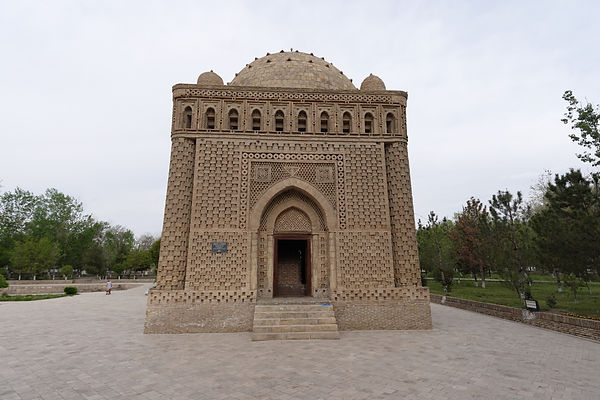
Ismail Samani Mausoleum: This detailed but humble looking 1 room building was built in the 905, according to legend, as the final resting place for the father of Ismail Samanid, the founder of the Samanid Dynasty. Both men, along with other Samanid royals, are buried here. This is possibly the oldest and best preserved buildings in Bukhara. Along with this, the mausoleum is one of the oldest burnt brick buildings in Central Asia. It's an impressive architectural feat for the time, and it takes the cubical shape from the Kaaba in Mecca.


Samarkand
Registan, Bibi-Khanym Mosque, Amir Temur Mausoleum (Gur-e-Amir), and Shah-i-Zinda
This without a doubt one of the, if not the, most splendid and magnificent Silk Road cities still in existence today. Like most Central Asian cities, Samarkand was destroyed by the Mongols in 1220. Later, it was rebuilt and expanded as the capital of the Timurid Dynasty (1370-1507) under Tamerlane. Many of the buildings there today are from this time period, including the madrassas in the Registan (the heart of the old town). It's one of the most impressive squares in the world.

Registan

Bibi-Khanym Mosque: Named after Tamerlane's wife, this complex appears to be the largest in the city (except for maybe the Registan) and the entrance is simply enormous. Although currently not completely finished/restored, these buildings are a bit controversial due to the size and scale of the rebuilding that has taken place since the 1970s. Actually, it was a massive, hurried, and overwhelming project even when it was originally built in the early 15th century. The mosque literally began to collapse in on itself given its unprecedented size upon its completion.
Amir Temur Mausoleum (Gur-e-Amir): Built in 1404 for Timur's grandson, this ended up being where Tamerlane himself was buried after dying in 1405. Other members of the family, including the intellectually oriented Ulugh Beg, are interred here as well. Unlike the other historic, turquoise domed buildings around town, the interior of this building is what leaves you mesmerized. The inside room holding the tombs is dimly lit while the textured and decorated walls/dome are finished in pure gold coloring with blue outlines and edges. It might be the most beautiful room in Samarkand.


Shah-i-Zinda: The name of this place means "Tomb of the Living King." Basically, there's a walking street up a hill that's covered with blue tiled mausoleums. This one lane contains some of the best tile work in the Muslim world. The buildings here, like most of the iconic structures, originate from the Timurid Dynasty in the 14-15th century. However, some of the shrines here, especially to the holy man Qusam, have origins much older than when the city was sacked by the Mongols in 1220. Likely, the Timurid aristocracy wanted to build their tombs here because of the ancient shrines that already had been in this area. Finally, you will need to by a ticket at the entrance.


Tashkent
I was here for 1 night before taking a train to Kazakhstan. I walked the city for several hours, had a few good meals, and found a nice coffee shop. I saw a few cool buildings, a North Korea stadium looking market, and I got to ride the subway (Tashkent has 4 line, although not all stops are operational). This is a big city, about 3 million people, and I prefer to move onto smaller places.


Chorsu Bazaar: This indoor/outdoor market is a popular shopping center selling many goods from groceries, fresh produce, bread, souvenirs, etc. It's a neat place to visit if you are in the city and you have some time to spend.